10: Lock and Condition Variables Design
OS Conceptual Framework
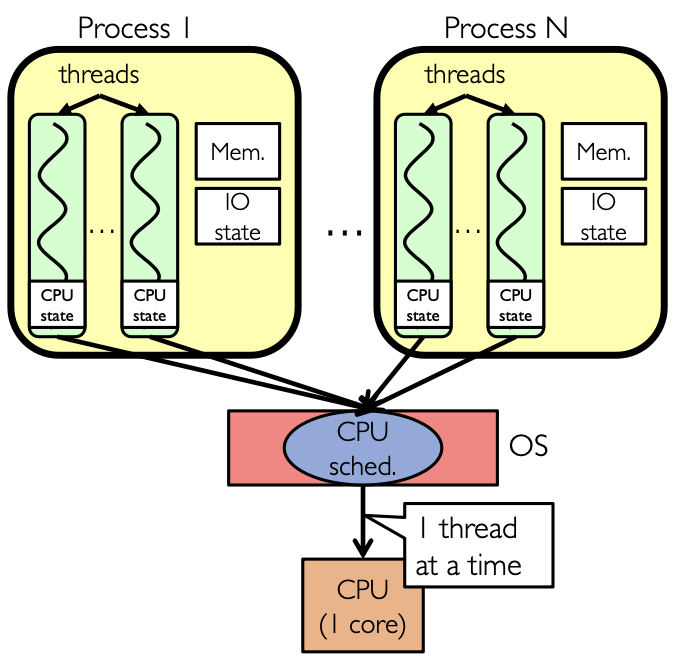
Figure 1: OS Conceptual Framework
- physical addresses shared
- processes and address translation
- CPU must be shared
- threads
- processes aren’t trusted
- kernel/user split
- threads might not cooperate
- user timer interrupts to context switch
Correctness for Systems with Concurrency
A dispatcher can schedule thread in any way, programs must work under all circumstances.
- independent threads
- no state shared with other threads
- deterministic \(\Rightarrow\) input state determines results
- reproducible \(\Rightarrow\) can recreate starting conditions, I/O
- scheduling order doesn’t matter
- cooperating threads
- shared state between multiple threads
- non-deterministic
- non-reproducible
Atomic Operations
Def. Atomic Operations: an operation that always runs to completion or not at all.
- it is indivisible: it cannot be stopped in the middle and state cannot be modified by someone else in the middle
- fundamental building block - if no atomic operations, then have no way for threads to work together
On most machines, memory references and assignments of words are atomic.
Many instructions are not atomic
- double-precision floating point store often not atomic
- VAX and IBM 360 had an instruction to copy a whole array
Some Definition
- Def. Synchronization: using atomic operations to ensure cooperation between threads
- for now, only loads and stores are atomic
- Def. Mutual Exclusion: ensuring that only one thread does a particular thing at a time
- one thread exclude the other while doing its task
- Def. Critical Section: piece of code that only one thread can execute at once
- critical section is the result of mutual exclusion
- critical section and mutual exclusion are two ways of describing the same thing
- Def. Lock: prevent someone from doing something
- lock before entering critical section and before accessing shard data
- unlock when leaving, after accessing shared data
- wait if locked
Lock
Suppose we have some sort of implementation of a lock
lock.Acquire()- wait until lock is free, then grablock.Release()- unlock, waking up anyone waiting- these must be atomic operations - if two threads are waiting for the lock and both see it’s free, only one succeeds to grab the lock
Three formal properties
- mutual exclusion: at most one thread holds the lock
- progress: if no thread holds the lock and any thread attempts to acquire the lock, then eventually some thread succeeds in acquiring the lock
- bounded waiting: if thread \(T\) attempts to acquire a lock, then there exists a bound on the number of times other threads can successfully acquire the lock before \(T\) does.
- yet, it does not promise that waiting threads acquire the lock in FIFO order
Conditional Variable
Def. Conditional Variable: a queue of threads waiting for something inside a critical section.
- key idea: allow sleeping inside critical section by atomically releasing lock at time we go to sleep
Operations:
wait(&lock): atomically release lock and go to sleep. Reacquire lock later, before returningsignal(); wake up one waiter, if anybroadcast(): wake up all waiters
Semaphores
Def. Semaphores are a kind of generalized lock.A semaphore has a non-negative integer value and supports the following two operations:
P(): an atomic operation that waits for semaphore to become positive, then decrements it by1- think of this as the
wait()operation
- think of this as the
V(): an atomic operation that increments the semaphore by1, waking up a waitingP, if any- think of this as the
signal()operation
- think of this as the
The Uses of Semaphores
- mutual exclusion (initial value
1) - schedule constraints (initial value
0)- allow thread 1 to wait for a signal from thread 2, i.e., thread 2 schedules thread 1 when a given event occurs
- example: suppose you had to implement
threadjoin()which must wait for thread to terminate
10: Lock and Condition Variables Design
https://ddccffq.github.io/2026/01/01/操作系统/Lock_and_Conditional_Variable_Design/