8: Demand Paging
Demand Paging
Modern programs require a lot of physical memory, but they don’t use all their memory all of the time.
90-10 rule: programs spend 90% of their time in 10% of their code.
Use main memory as cache for disk
Demand Paging as Cache
- What is block size
- 1 page
- What is organization of this cache (i.e. direct-mapped, set-associative, fully-associative)?
- fully associative: arbitrary virtual \(\to\) physical mapping
- How do we find a page in the cache when look for it?
- first check TLB, then page-table traversal
- What is page replacement policy? (i.e. LRU, Random…)
- What happens on a miss?
- go to lower level to fill miss (i.e. disk)
- What happens on a write? (write-through, write back)
- write-back – need dirty bit
Memory-Mapped Files
Def. Memory-mapped Files (内存映射文件) is a segment of virtual memory that has been assigned a direct byte-for-byte correlation with some portion of a file or file-like resource.
- a special case of demand paging
- a replacement for syscall
read()/write()
Pros
- transparency - the program can use pointers to access those data
- zero copy I/O - the OS just changes the page table entries without copying the data into memory;
read()/write()needs to copy the data twice (disk-kernel-user) - pipelining - the program can start executing as soon as the page table has been set
- inter-process communication - sharing becomes easy
- large files - which pages shall be in memory? OS handles it for you
Cons
- frequent page faults
Use m-map when
- random access: access data in a non-sequential manner
- large files: for very large files that may not fit into memory
- multiple processes: data sharing across processes
- memory-mapped I/O and automatic caching
Instead, use read()/write() when
- small files
- streaming data access
- portability: not every OS has m-map
Implementation of Memory-Mapped Files
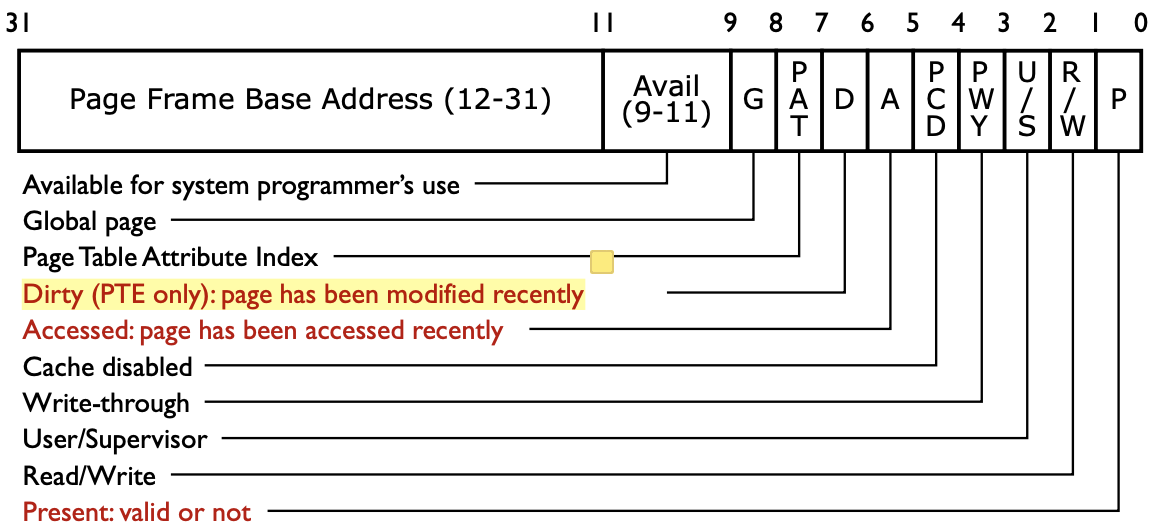
Figure 1: Page Table Entry
D(dirty): PTE only, page has been modified recentlyA(accessed): page has been accessed recently
When program accesses an invalid address:
- (MMU) TLB miss; full page table lookup
- (MMU + OS) trap into page fault handler
- (OS) convert virtual address to file offset
- (OS) read data from disk to the memory (blocked)
- (CPU) disk interrupt when read completes
- (OS) updating page table by marking the entry as valid
- (MMU) TLB miss; full page table lookup
- (MMU) TLB update
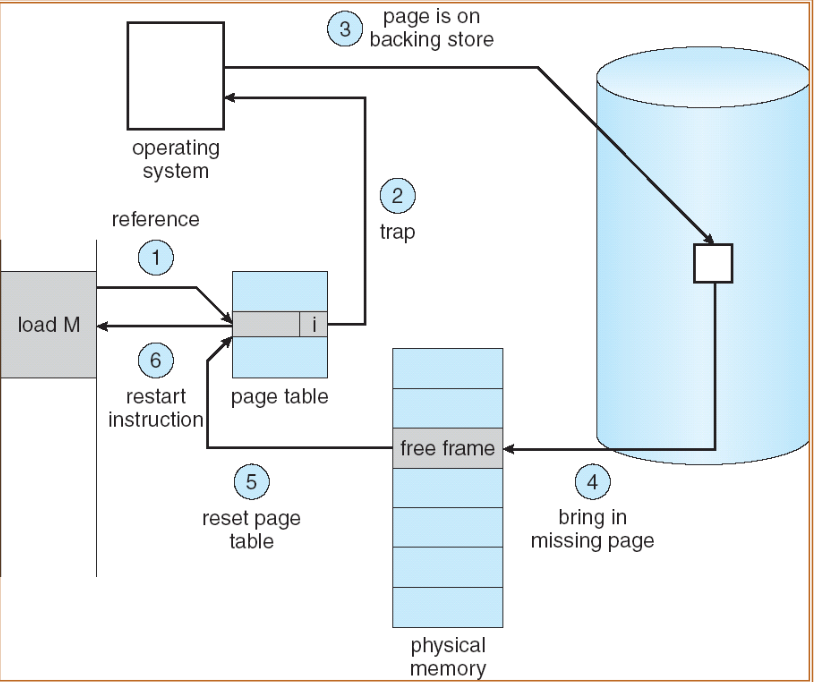
Figure 2: When program accesses an invalid address
The Dirty Bit
The hardware tracks it with a dirty bit in page table entry
- initialized to 0
- Set to 1 whenever there is a store instruction for the page
The TLB also has a dirty bit
Allocating New Page Frame
If there is no empty page
- select a page to evict
- find page table entries that point to the evicted page
- core map - an array that maps physical page frames back to the table entries
- set page table entry to invalid
- TLB shoot down
- copy back any changes to the evicted page
- write back
- the same for application exit
- dirty bit
Page Eviction Policies
- FIFO: throws out oldest page. Let every page live in memory for same amount of time.
- MIN: replaces page that won’t be used for the longest time
- RANDOM: picks random page for every replacement
- typic solution for TLB
- LRU: replaces page that hasn’t been used for the longest time
- programs have locality, so if something not used for a while, unlikely to be used in the near future
- how to implement LRU? Use a list
- on each use, remove page from list and place at head
- LRU page is at tail
- problems with this scheme for paging
- need to know immediately when each page is used, so we can change its position in list
- many instructions for each hardware access
- 页面访问及其频繁,开销过大
Why we can implement LRU for TLB entry replacement, but not demand paging replacement?
- TLB is purely handled in hardware (MMU)
- TLB has fewer entries (typically 16-512)
Clocking Algorithm
- implementation with the
usebit- initialized to 0 in page table
- set to 1 whenever there is a page access
- when we need to evict a page, we look at the page under the hand
- if its
usebit is 1, clear it and move the hand, repeat - if its
usebit is 0, evict it
- if its
开销分析
- 驱逐开销变大
- 访问几乎没有开销
可以适当增加
usebit 的上限Which bits of PTE entry are used?
- Use: set when page is referenced; cleared by clock algorithm
- Modified: set when page is modified, cleared when page written to disk
- Valid: ok for program to reference this page
- Read-Only: ok for program to read page, but not modify
8: Demand Paging
https://ddccffq.github.io/2025/12/31/操作系统/Demand Paging/