数据库系统原理期中试题解答
一
给出下列关系代数操作对应的 SQL 语句
\(\sigma_{p = 233}(r)\)
1
SELECT * FROM r WHERE p = '233';\(\Pi_{A_1, A_2, \cdots, A_m}(r)\)
1
SELECT A_1, A_2, \cdots, A_m FROM r;\(\Pi_{A_1, A_2}(\sigma_{p = 114}(r))\)
1
SELECT A_1, A_2 FROM r WHERE p = '114';\(\Pi_{A, B}(\sigma_{B = 114}(r \Join S))\),假设 \(r(A, B, C)\),\(s(C, E, F)\)。
1
SELECT r.A, r.B FROM r JOIN s USING (C) WHERE r.B = '114';
二
给出下列 SQL 语句对应的关系代数表达式
SELECT * FROM student WHERE SNO = '10086';\[ \sigma_{\text{SNO} = 10086}(\text{Student}) \]
SELECT Name, Class FROM Student WHERE SNO = '10086';\[ \Pi_{\text{Name}, \text{Class}}(\sigma_{\text{SNO} = 10086}(\text{Student})) \]
SELECT Name FROM Student, SC WHERE SC.SNO = Student.SNO AND SC.CNO = '1';\[ \Pi_{\text{Name}}(\sigma_{\text{Student.SNO} = \text{SC.SNO} \land \text{SC.CNO = 1}}(\text{Student} \times \text{SC})) \]
SELECT R.*, S.C FROM R , S WHERE R.A = S.A;,假设 \(R(A, B)\),\(S(A, C)\)\[ \Pi_{R.A, R.B, S.C}(\sigma_{R.A = S.A}(R \times S)) \]
三
某银行企业数据库关系如下,划线部分为主键
| 表 | 属性 |
|---|---|
| branch | \(\underline{\text{branch-name}}\), branch-city, assets |
| loan | \(\underline{\text{loan-number}}\), branch-name, amount |
| borrower | \(\underline{\text{customer-name}}\), \(\underline{\text{loan-number}}\) |
| customer | \(\underline{\text{customer-name}}\), customer-street, customer-city |
| account | \(\underline{\text{account-number}}\), branch-name, balance |
| depositor | \(\underline{\text{customer-name}}\), account-number |
| employee | \(\underline{\text{employee-ID}}\), employee-name, branch-name, job-title |
使用 SQL 语句定义关系表 employee,其中 employee-ID 是主键,employee-name 是候选键并且不为空;表 employee 和 branch 之间存在参照完整性;员工的职位必须是 manager,teller,officer,secretary 之一。
1
2
3
4
5
6
7
8
9
10
CREATE TABLE employee (
employee_ID VARCHAR(5) NOT NULL,
employee_name VARCHAR(10) NOT NULL,
branch_name VARCHAR(10) NOT NULL,
job_title VARCHAR(9) NOT NULL,
PRIMARY KEY (employee_ID),
UNIQUE (employee_name),
CHECK (job_title in ('manager', 'teller', 'officer', 'secretary')),
FOREIGN KEY (branch_name) REFERENCES branch(branch_name)
);使用 SQL 语句查找在 Raccoon 市有一个或多个账户,并且这些账户的余额总额超过 10000 元的客户信息。列出客户的姓名和他在 Raccoon 市分支机构的账户总余额,客户姓名的字母降序排列。
1
2
3
4
5
6
7
8
SELECT d.customer_name, SUM(a.balance) AS balance_in_Raccoon
FROM depositor d
JOIN account a on d.account_number = a.account_number
JOIN branch b on a.branch_name = b.branch_name
WHERE b.branch_city = 'Raccoon'
GROUP BY d.customer_name
HAVING SUM(a.balance) > 10000
ORDER BY d.customer_name DESC;
四
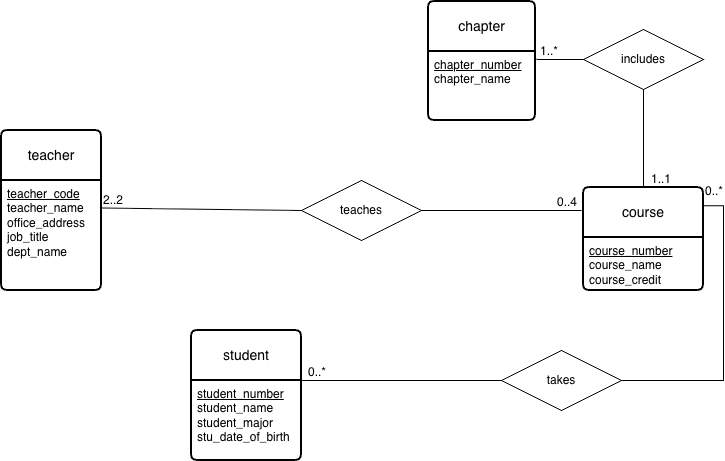
- 每位老师有教师代码(唯一)、教师姓名、办公地址、职级、部门。
- 每门课程有课程名称、课程编号(唯一)、课程学分。课程包含章节,每个章节有一个编号(唯一)和章节名,同一门课程可能有多个章节。
- 每个学生有学生编号(唯一)、姓名、专业、出生日期。
- 一位老师最多可以教四门课程,每门课程由两位老师教授。
- 一个学生可以选择多门课程,每门课程可以由多个学生选择。
五
将下面的 E-R 图转换为相应的关系模型。对于每个模型,用 R(\(\underline{\text{A1, A2}}\), \(\cdots\), An) 的形式写出来,用下划线标出主键,并用 R.A1(FK) References S.A2(PK) 的形式说明外键。
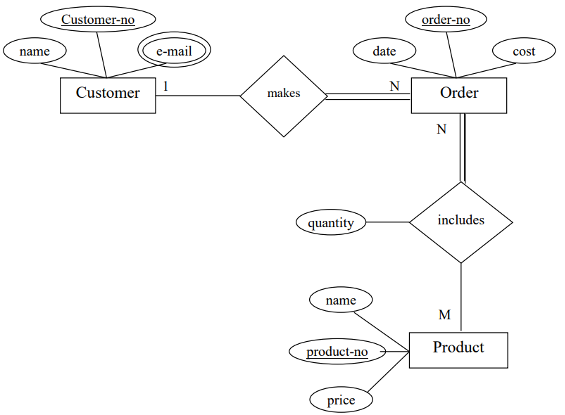
Customer(\(\underline{\text{Customer-no}}\), name, e-mail), Order(\(\underline{\text{order-no}}\), date, cost, Customer-no), Product(\(\underline{\text{product-no}}\), name, price) includes(\(\underline{\text{order-no}}\), \(\underline{\text{product-no}}\), quantity), Order.Customer-no(FK) References Customer.Customer-no(PK), includes.order-no(FK) References Order.order-no(PK), includes.product-no(FK) References Product.product-no(PK).
六·
A university student database needs to store information about \(\underline{\mathit{students}}\), \(\underline{\mathit{professors}}\), \(\underline{\mathit{projects}}\), and \(\underline{\pmb{departments}}\). Consider the following information:
- Each student has an SNo, a name, an age, and a degree program (e.g. M.S. or Ph.D.).
- Each professor has a PNo, a name, an age, and a research specialty.
- Each project has a project number, a starting date, an ending date, and a budget.
- Each department has a department number, a department name, and a main office.
- integrity constraints:
- A student studies in one (and only one) department.
- A Professor works in one (and only one) department.
- Each project must be managed by one and only one professor, and each professor must manage at least one project.
- Each project is worked on by some students, more than one student can participate(or work on) the same project, and some students may work on no projects.
- When a student work on a project, the professor managing this project must supervise the student’s work. One student may work on several projects, so he may have several supervisors.
Design and draw an E/R diagram for this database that captures the information above. > Note: mapping cardinality of each relationship and participation of each entity to the relationship should be described in the diagram.
.png)
Convert the E-R diagram to the proper relational schema, and give the primary key of each relation schema by underlines.
student(\(\underline{\text{SNo}}\), stu_name, stu_age, stu_degree, dept_number), professor(\(\underline{\text{PNo}}\), pro_name, pro_age, research_specialty, dept_number), project(\(\underline{\text{project\_number}}\), start_date, end_date, budget, PNo), department(\(\underline{\text{dept\_number}}\), dept_name, main_office), works_on(\(\underline{\text{student.SNo}}\), \(\underline{\text{project.project\_number}}\)), supervise(\(\underline{\text{student.SNo}}\), \(\underline{\text{professor.PNo}}\), project_number).
七
Consider the following relation schema \(R\) and the functional dependency \(F\) hold on \(R = \{X, Y, Z, W, Q\}\), \(F = \{XY \to ZQ, Q \to XY, Z \to W, Q \to Z\}\)
Compute \((XZ)+\).
由 \(Z\to W\) 可得 \(W\);无法由 \(XZ\) 推出 \(Q\) 或 \(Y\)(需要 \(Q\) 或 \(XY\) 才能触发 \(Q\to XY\) 或 \(XY\to ZQ\)),因此闭包为 \(\{X,Z,W\}\)。
Is the decomposition \(\rho = \{R1(X, Y, Z), R2(Z, W, Q)\}\) on \(R\) lossless-join? Why?
交集为 \(R_1\cap R_2=\{Z\}\)。检查 \(Z^+=\{Z,W\}\),既不是 \(R_1(X,Y,Z)\) 的超码,也不是 \(R_2(Z,W,Q)\) 的超码;不满足二元分解无损充要条件“交集函数决定其中一个模式”,故分解有损。
八
The functional dependency set \(F = \{A \to C, C \to A, B \to A, D \to AC, B \to E\}\) holds on the relation schema \(R = (A, B, C, D, E)\).
Compute \((AB)+\).
由 \(B\to A\)、\(A\to C\)、\(B\to E\) 依次可得 \(A,C,E\);无规则推出 \(D\)。
List all the candidate keys of \(R\).
\(D\to AC\),配合 \(B\to A, B\to E\) 得 \(BD\to ABCDE\),且 \(B\) 与 \(D\) 分别不能由其它属性函数确定(右部无 \(B\)、\(D\)),因此 \(BD\) 最小且为唯一候选键。